
Double Dragon
The Lee brothers in an endlessly scrolling world, weapons picked up from enemies and a co-op mode that launched an era. The game that made the beat'em up a genre in its own right.
 Certified scoring
 Get the game
Double Dragon
- Developer
- Technōs Japan
- Publisher
- Taito
- Release
- 1987
- System
- Arcade
- Players
- 1-2
- Genre
- Beat'em up
The story of the game
The why and the how
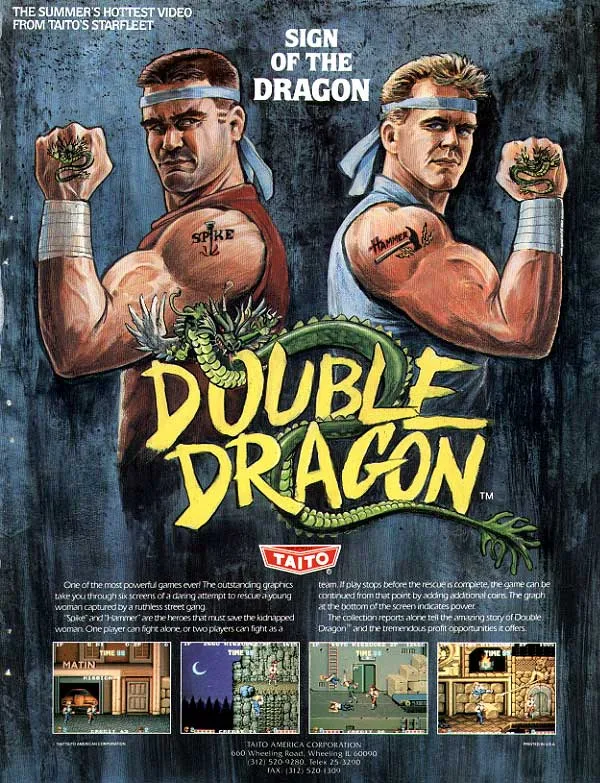
Double Dragon is a beat'em up developed by Technōs Japan and published by Taito for the arcade in 1987. In spirit and technique it follows Nekketsu Kōha Kunio-kun, released in 1986 and sold outside Japan as Renegade. It was Japan's third most profitable tabletop arcade game in 1987, then the most profitable dedicated arcade game in the United States in 1988 and 1989. Electronic Gaming Monthly crowned it game of the year in 1988.
How it was made
Yoshihisa Kishimoto, creator of Nekketsu Kōha Kunio-kun, directed the development. His seniors asked him for a new game, preferably for two players, more profitable in arcades. He first thought of a direct sequel to Kunio-kun, before devising a visual style for an international audience. The title alludes to the pair of players and to the film Enter the Dragon, with Bruce Lee, which inspired the game greatly. The settings and aesthetics also owe a debt to Mad Max and the manga Fist of the North Star.
What makes it unique
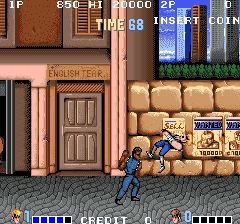
You play Billy Lee, or his twin brother Jimmy, who attack the lair of the Black Warriors gang to rescue Marian, Billy's girlfriend. The world scrolls without interruption, unlike Kunio-kun's arenas, with the possibility of arming yourself with the weapons of a disarmed enemy: bats, whips, throwing knives or dynamite. One player can even grab an opponent from behind while the other hits him. Four missions lead from the suburbs to the factory, the forest, then the lair.
Good to know
Each mission is played against the clock: a life is lost when the life gauge or the timer reaches zero, or when falling into a hole, a river or spikes. The player has a certain number of spare lives. Techniques, punches, kicks, throws and elbow strikes, combine depending on the situation. With two players, one can hold an opponent from behind while the other strikes, and some enemies can do the same.
Its influence
The game's success launched the Double Dragon series, with two arcade sequels and several spin-offs. It opened a golden age of the beat'em up, setting its conventions for a wave of games from other publishers in the late 1980s and the 1990s. It was adapted for the NES and numerous home computers.
Text written from published sources (Wikipedia, Wikidata, specialist press).
The hardware
Texts and media: ScreenScraper.fr. Trademarks and visuals belong to their owners.