

Ghouls 'n Ghosts
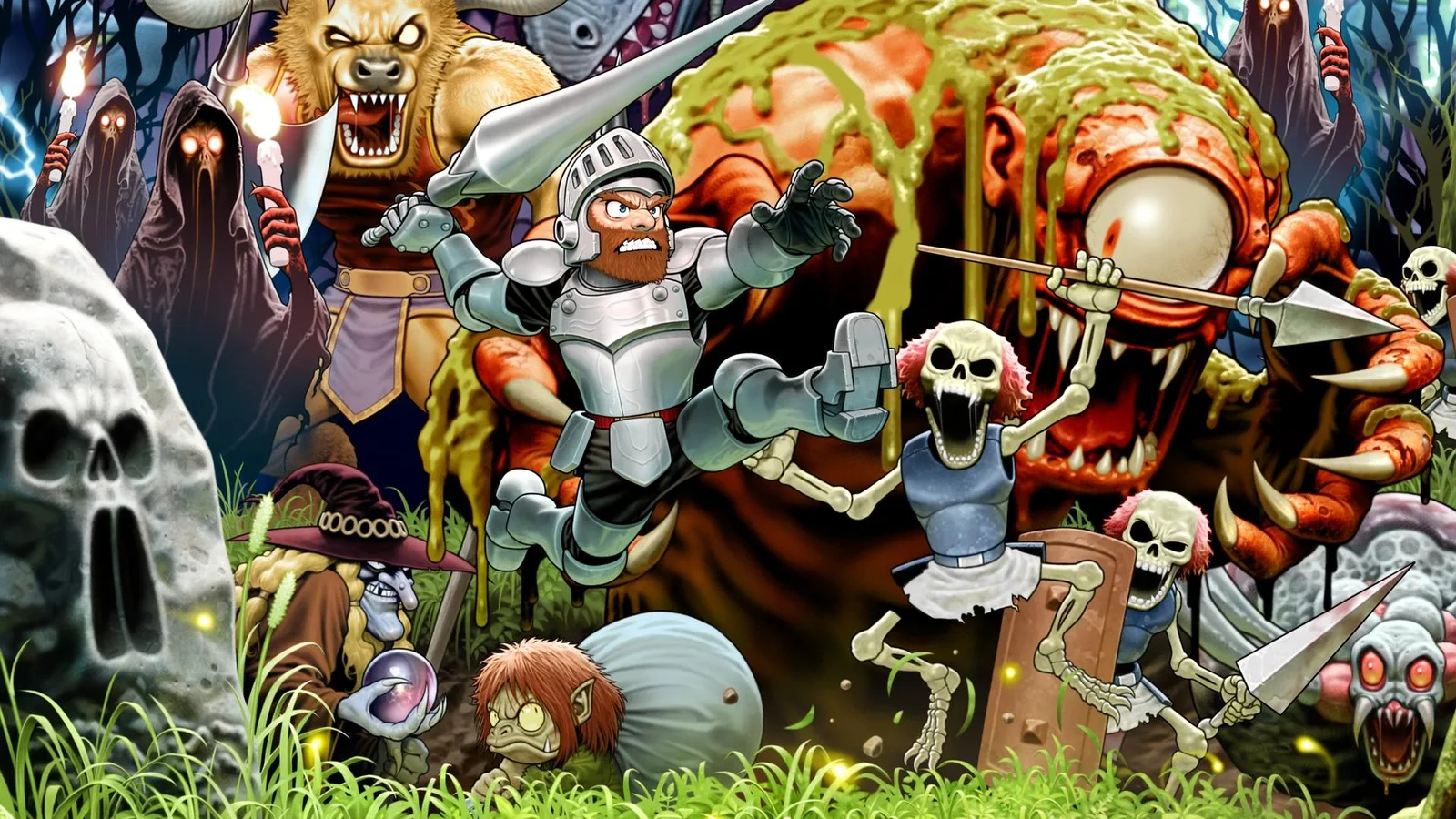
Arthur puts the armor back on: the sequel to Ghosts 'n Goblins, richer in weapons, now shoots upward and downward.
 Get the game
Ghouls 'n Ghosts
- Developer
- Capcom
- Publisher
- Capcom
- Release
- 1988
- System
- Arcade
- Players
- 1-2
- Genre
- Platforming and run and gun
The story of the game
The why and the how
Ghouls 'n Ghosts, called Dai Makaimura in Japan, is a 1988 platform game developed and published by Capcom for the arcade. It is the sequel to the 1985 Ghosts 'n Goblins and the second game in the series. It was a commercial success, the eighth highest-grossing arcade game of 1989 in Japan. The Mega Drive version was also praised by critics, with four Electronic Gaming Monthly awards in 1989, including best game of the year.
How it was made
The cabinet's soundtrack is by Tamayo Kawamoto. Many computer ports reuse a soundtrack by Tim Follin, made of arrangements and original pieces, respected by game music fans, especially on Commodore 64, Atari ST and Amiga. The 1989 European versions, on Amstrad CPC, Amiga, Atari ST, Commodore 64 and ZX Spectrum, are the work of Software Creations and leave out many details of the cabinet.
What makes it unique
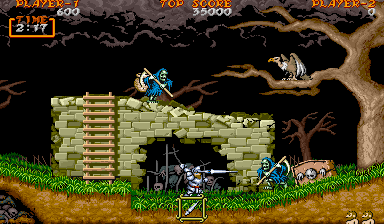
The story takes place three years after the first installment: the kingdom is attacked by ghosts and ghouls, and Princess Prin-Prin is among the stolen souls. Sir Arthur sets out to defeat Lucifer and his demons. The principle stays close to the original, with a series of sinister levels and weapons and armor to pick up, but Arthur can now shoot straight up and down while in the air. By jumping in certain spots, a chest pops up, which may contain a weapon, golden armor or a magician who turns Arthur into an old man or a duck.
Good to know
Sir Arthur must cross sinister levels and defeat numerous undead and demonic creatures to restore life to all of Lucifer's victims, including his beloved, Princess Prin-Prin. Along the way, he picks up a variety of weapons and armor. The principle stays close to Ghosts 'n Goblins: it is therefore the equipment found that decides his resilience, and the knight loses it when hit.
Its influence
Sega released the Mega Drive conversion, programmed by Yuji Naka, in 1989 in Japan and North America, then in 1990 in Europe. It was re-released on the Wii virtual console in 2007, in the Sega Genesis Mini in 2019 and on Nintendo Classics in 2023. The 1991 Master System conversion adds secret shops where you can upgrade the helmet, which gives access to new weapons and spells, the breastplate, which absorbs more damage, and the boots, which increase speed. NEC Avenue released a SuperGrafx version in 1990.
Text written from published sources (Wikipedia, Wikidata, specialist press).
The hardware
Texts and media: ScreenScraper.fr. Trademarks and visuals belong to their owners.