
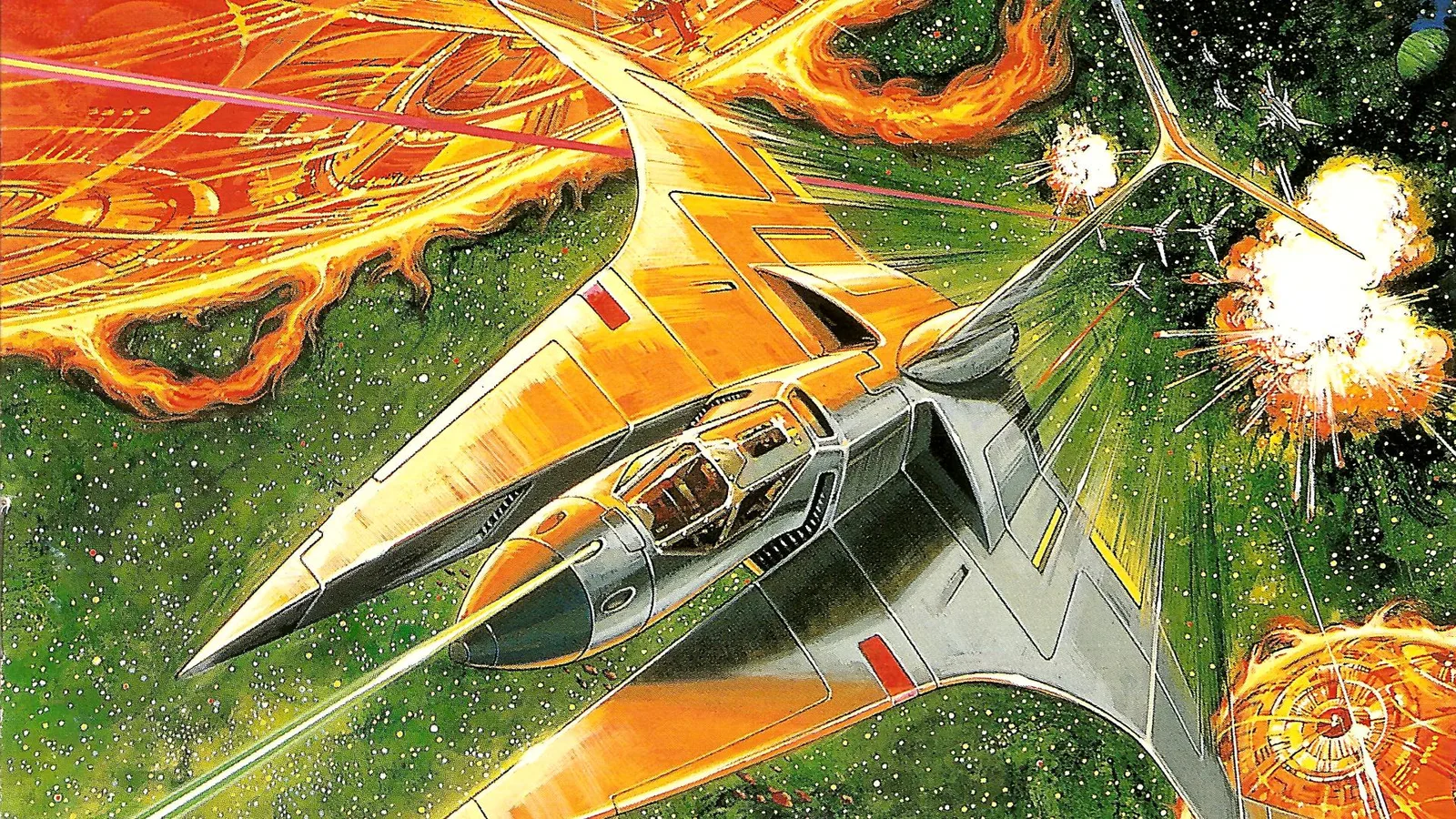

Gradius II
The second Gradius, released in 1988, which takes over the weapons of Salamander and a new boss with a giant head.
 Certified scoring
 Get the game
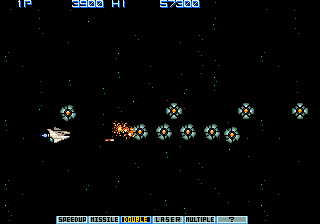
Gradius II
- Developer
- Konami
- Publisher
- Konami
- Release
- 1988
- System
- Arcade
- Players
- 1-2
- Genre
- Horizontal shoot'em up
The story of the game
The why and the how
Gradius II, renamed Vulcan Venture in North American arcades, is a 1988 horizontal scrolling shooter developed and published by Konami. It is the sequel to Gradius, followed by Gradius III. It first came out in arcades, with ports to Famicom, PC Engine Super CD-ROM² and X68000 in Japan. The original cabinet is included in the Gradius Deluxe Pack compilation on PlayStation and Saturn.
How it was made
After Salamander, Konami took time to let new ideas mature before starting the sequel, spurred on by players' requests. Kouji Hiroshita, head of the arcade section, recalls a development of about five months, begun after the AM show so as to be ready for the AOU show. The team first dreamed of weapons that could be freely combined, such as a ground laser or homing missiles, then settled on four configurations meant to balance one another. The Moai stage was built first, the artificial sun stage next. The second stage, organic at first in the manner of Salamander, was drawn almost entirely by one of the team's designers. The final base and the volcano came last, so that the game would stay true to Gradius.
What makes it unique
The player resumes the role of the Vic Viper pilot to face the second offensive of the Bacterion Empire, now under the leadership of Gofer, a giant head. The game keeps the gameplay of the first while adding improvements from the spin-off Salamander (Life Force), most visible in two of the selectable weapon configurations.
Good to know
Gradius II loops endlessly: once the eight stages are cleared, the game starts again from the first with higher difficulty, and from the second loop on every destroyed enemy fires back bullets, a pressure that peaks at the fourth loop. The arcade revision used by Nelfe Play, the most recent one, gives an extra life at 20,000 points and then every 150,000, whereas the earliest versions gave one every 70,000. Those older versions also hid a flaw in the fifth stage: staying in a safe spot through the jumping Moai section paid 48,000 points when they left, enough to earn a life and start over forever. The fixed version only gives 1,600, and it is the one used by every re-release.
Its influence
Gradius II ranked as the third highest-earning arcade game in Japan in 1988. It was ported to the Famicom in 1988, to the PC Engine Super CD-ROM² in 1992 with an extra stage, then collected in the Gradius Deluxe Pack in 1996 on PlayStation and Saturn. It was not until Gradius Collection on PlayStation Portable, in 2006, that it saw a worldwide release, North America having had no version before. Hamster published it in its Arcade Archives line on PlayStation 4 in 2016 and on Nintendo Switch in 2020, and Konami included it in the Arcade Classics Anniversary Collection. The game follows Gradius and precedes Gradius III.
The development period was extremely short, only about 5 months I think.
Text written from published sources (Wikipedia, Wikidata, specialist press).
The hardware

Texts and media: ScreenScraper.fr. Trademarks and visuals belong to their owners.