
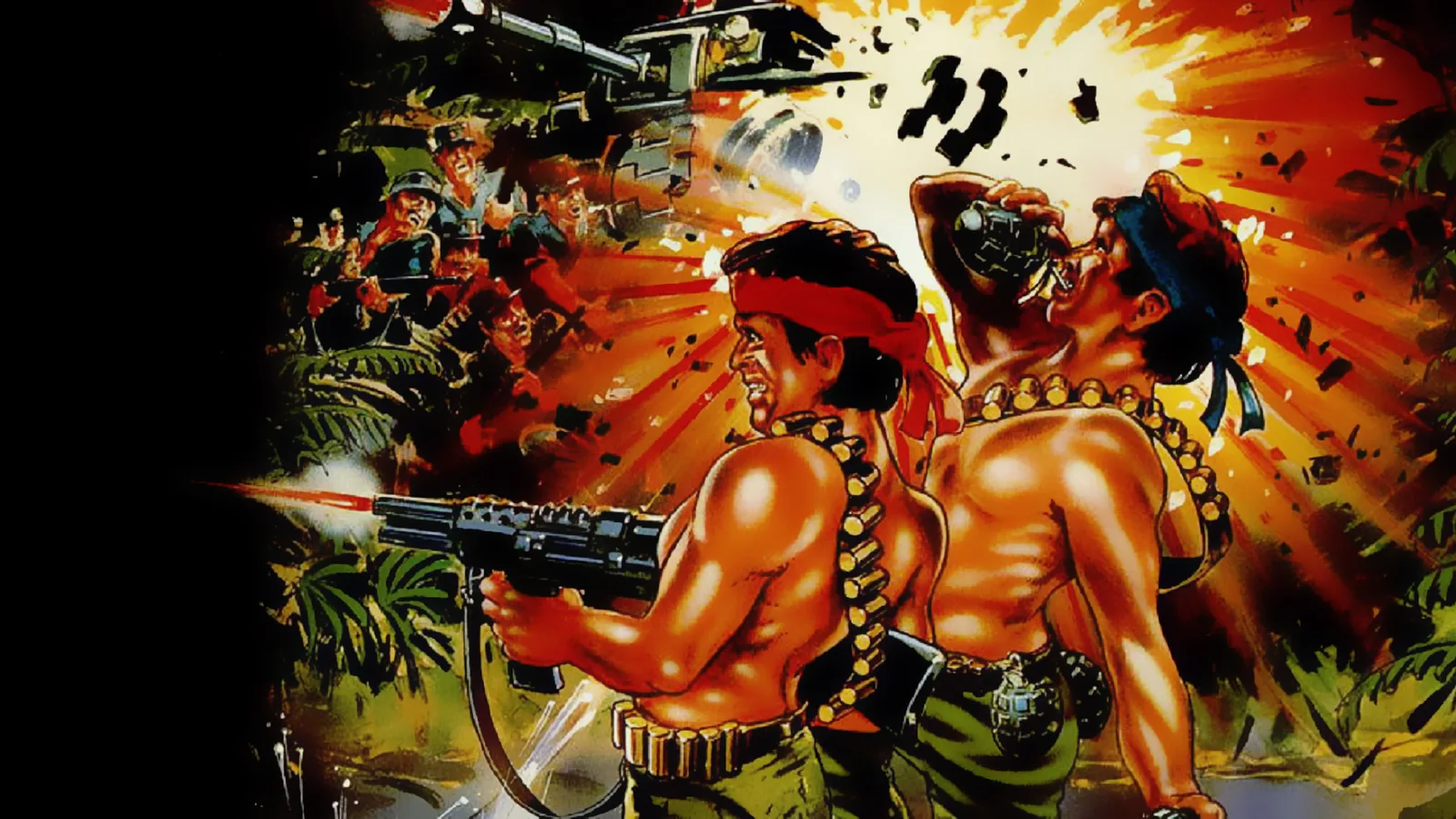
Ikari Warriors
The game that made SNK known in the West: two commandos, rotating joysticks and a village to reach under enemy fire.
 Get the game
Ikari Warriors
- Developer
- SNK
- Publisher
- SNK
- Release
- 1986
- System
- Arcade
- Players
- 1-2
- Genre
- Run and gun
The story of the game
The why and the how
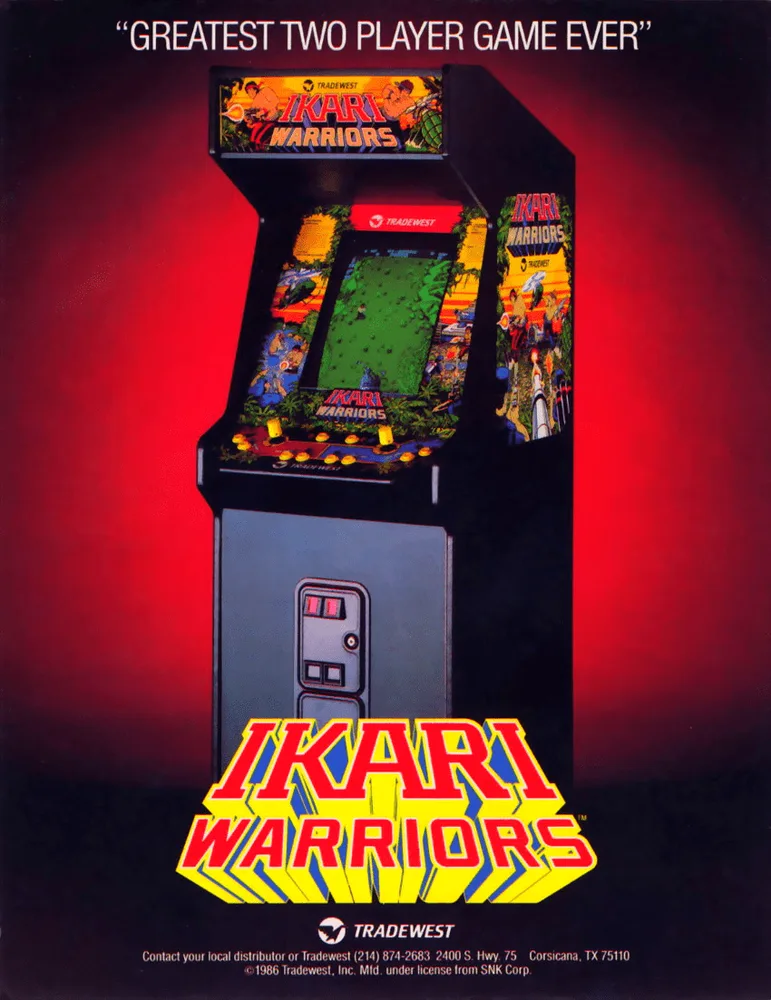
Ikari Warriors, called Ikari in Japan, came out in arcades on February 19, 1986, developed and published by SNK. Tradewest distributed it in North America. Among the many Commando clones, it stands out for its rotary controls and its two-player co-op mode. Those joysticks were inspired by TNK III, released in 1985. The game was originally meant to be a licensed adaptation of the film Rambo: First Blood Part II, but SNK had at first not obtained the rights.
How it was made
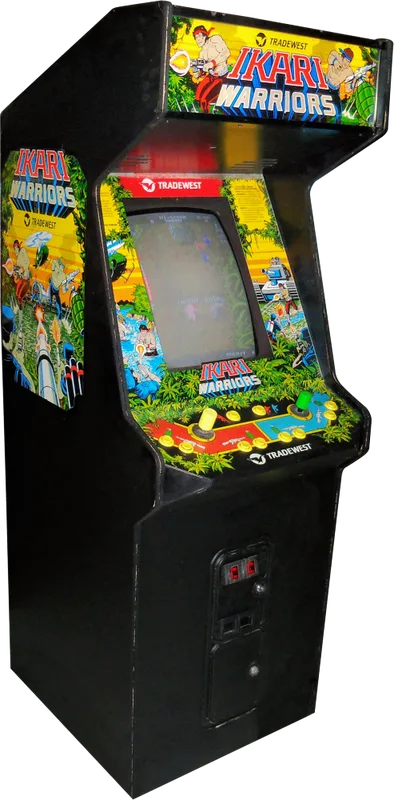
The cabinets use SNK's LS-30 joystick, which contains a twelve-position rotary switch: you can push it in eight directions and twist it. Two boards were produced, one with SNK pinout, the other with JAMMA pinout, the latter sold mostly in conversion kits. The director and designer is Koji Obata, programming is credited to Daimajin, and the graphics to Tama and Keiko Iju.
What makes it unique
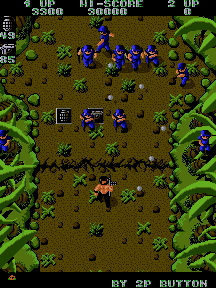
Colonel Ralf Jones, in red, and Lieutenant Clark Still, in blue, must reach the village of Ikari to free Colonel Cook. You advance toward the top of the screen, facing soldiers, tanks and helicopters. Turning the joystick changes the direction of fire without changing the direction of walking. One button fires the machine gun, another the grenades. You can take control of tanks, which are protected from bullets but limited by fuel.
Good to know
You have to keep moving: if the player takes too long to climb up the screen, the computer launches a supporting strike that chases the hero, shown by a red dot at his feet. Speed therefore comes first, as does managing the fuel of the tanks and the grenades.
Its influence
Ikari Warriors was a huge success: the second most profitable table cabinet in Japan in 1986, and in the US top 5 two years running, 1986 and 1987. For SNK it was a breakthrough in the United States. It spawned Victory Road, then Ikari III, and numerous ports to the Apple II, Amiga, Atari, Commodore 64, NES, MS-DOS, MSX2 and ZX Spectrum.
Text written from published sources (Wikipedia, Wikidata, specialist press).
The hardware
Texts and media: ScreenScraper.fr. Trademarks and visuals belong to their owners.