
Marvel Super Heroes
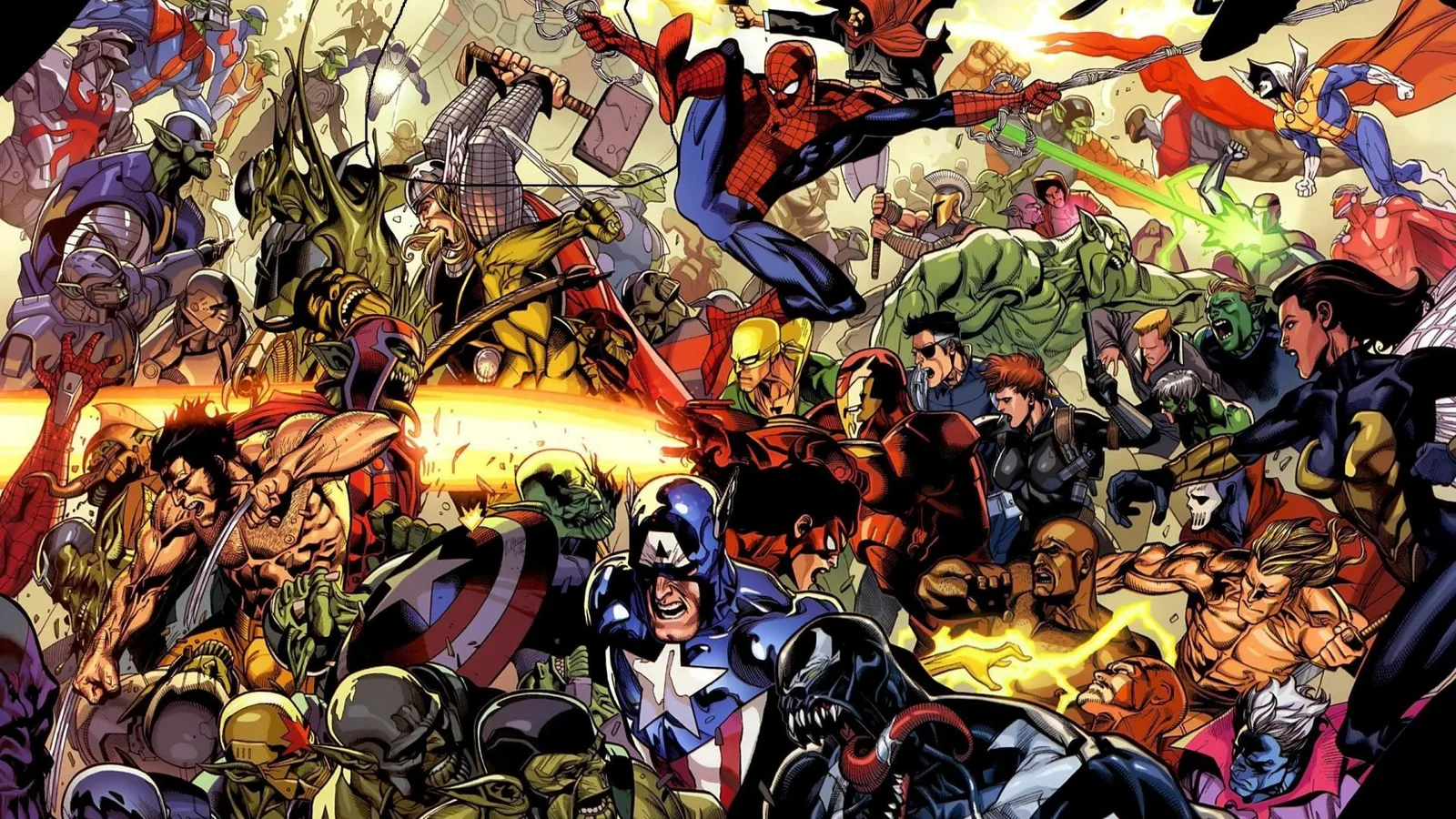
Capcom ventures into the Marvel universe with the Infinity Gauntlet story: Thanos and his six Infinity Gems at the center of the game. A colorful fighter, dedicated to Jack Kirby.
 Get the game
Marvel Super Heroes
- Developer
- Capcom
- Publisher
- Capcom
- Release
- 1995
- System
- Arcade
- Players
- 1-2
- Genre
- Fighting game
The story of the game
The why and the how
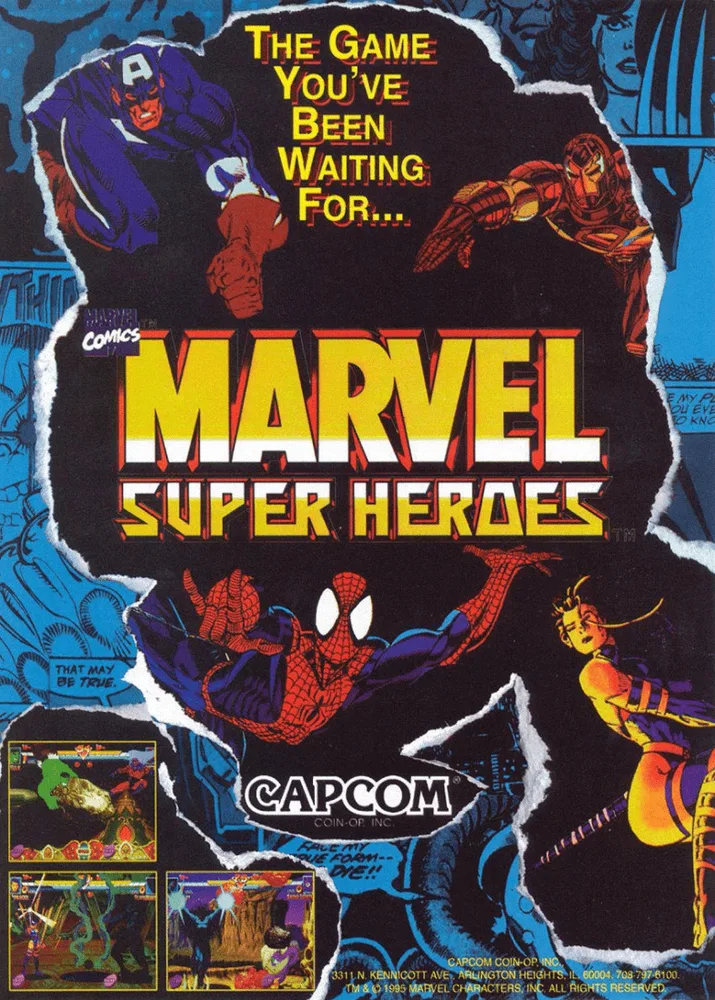
Marvel Super Heroes is a Capcom fighting game released in arcades in 1995 on the CPS-2 board. It is Capcom's second fighting game devoted to Marvel Comics characters, after the 1994 X-Men: Children of the Atom, and it would be followed in 1996 by X-Men vs. Street Fighter. It is loosely inspired by the Infinity Gauntlet story, in which Thanos wants to seize the Infinity Gems to dominate the universe. It is dedicated to the artist Jack Kirby, who died on 6 February 1994.
How it was made
Capcom carried over four characters from X-Men: Children of the Atom, those its market research identified as the most popular: Wolverine, Juggernaut, Magneto and Psylocke. The home versions were presented on the first day of E3 1996, with Stan Lee at the booth. The Saturn version uses the 1 MB memory expansion to add animation frames. In Europe, Virgin Interactive delayed it to 24 January 1998 to sell it with that expansion.
What makes it unique
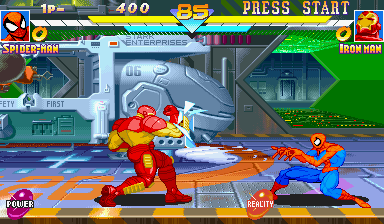
The aim is to defeat the opponent or have more health at the end of the round. A super gauge enables the powerful Infinity Combo attacks. The Infinity Gems, Power, Time, Space, Reality, Soul and Mind, are a separate mechanic: you get them by taking them from your opponents in arcade mode, or by meeting criteria in versus mode, such as landing the first hit. Each grants a strengthened effect for a short time.
Good to know
The Infinity Gems, Power, Time, Space, Reality, Soul and Mind, are the game's own resource. To win, you knock out your opponent or finish the round with more life than he has. As the match goes on, you fill a super gauge that powers the mighty Infinity Combos. Thanos, who wants to use the gems to dominate the universe, plays the antagonist. A trick, valid only on the Japanese version, lets you play the bosses: go through the service menu and enable free play before starting the game.
Its influence
Released on Saturn and PlayStation in 1997, the game came out again in 2012 with Marvel vs. Capcom: Clash of Super Heroes in Marvel vs. Capcom Origins on Xbox 360 and PlayStation 3. It was announced in 2019 for Marvel's Arcade1Up cabinet, then included in September 2024 in the Marvel vs. Capcom Fighting Collection: Arcade Classics. Game Machine had ranked it eleventh among Japan's arcade games in December 1995.
Text written from published sources (Wikipedia, Wikidata, specialist press).
The hardware
Texts and media: ScreenScraper.fr. Trademarks and visuals belong to their owners.