
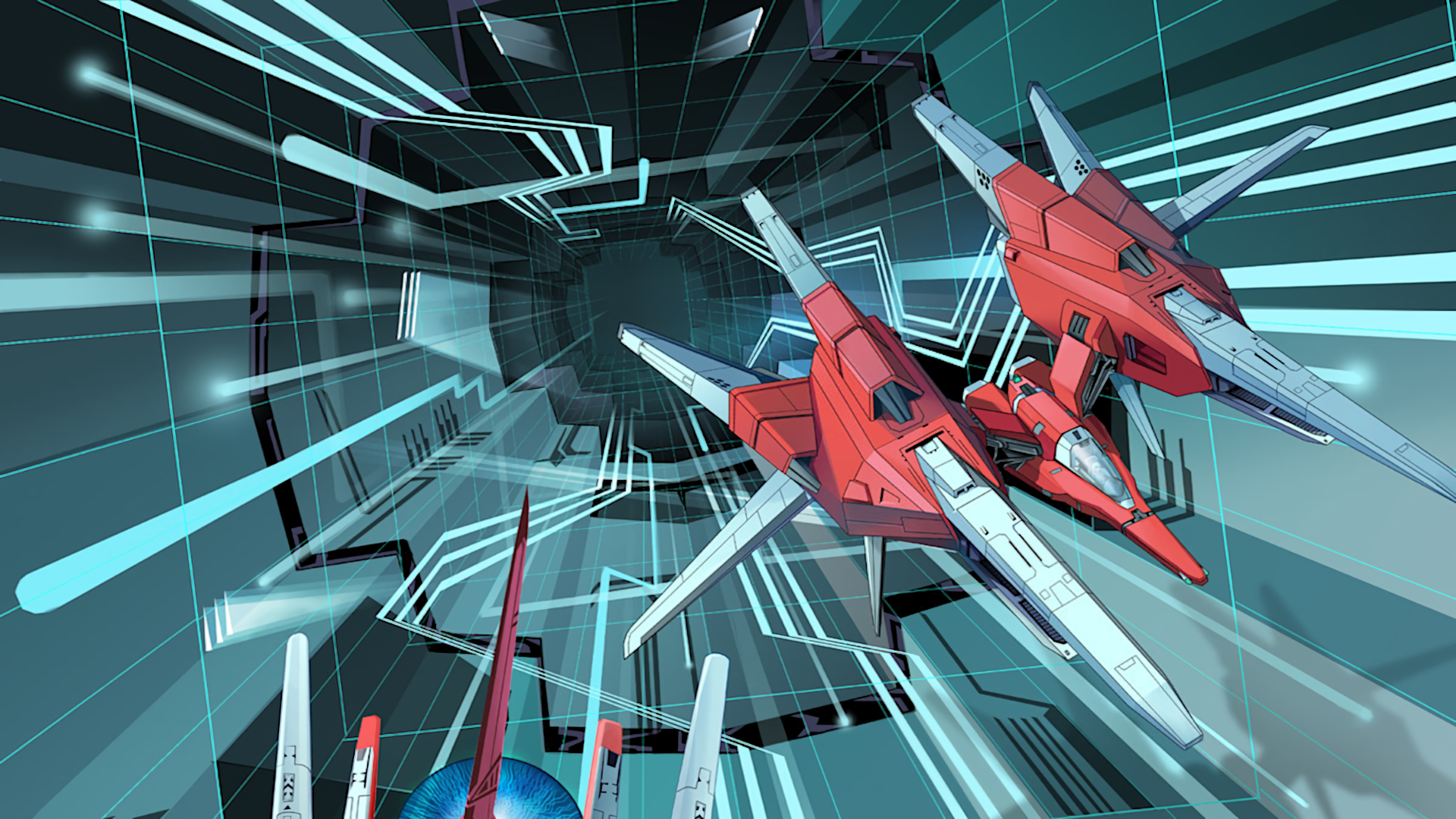

RayForce
A Taito shoot'em up where ground targets are aimed at by laser, several at once, and where there is no emergency bomb. One ship against a fortress planet, and a game that changed its name from country to country.
 Certified scoring
 Get the game
RayForce
- Developer
- Taito
- Publisher
- Taito
- Release
- 1994
- System
- Arcade
- Players
- 1-2
- Genre
- Vertically scrolling shoot'em up
The story of the game
The why and the how
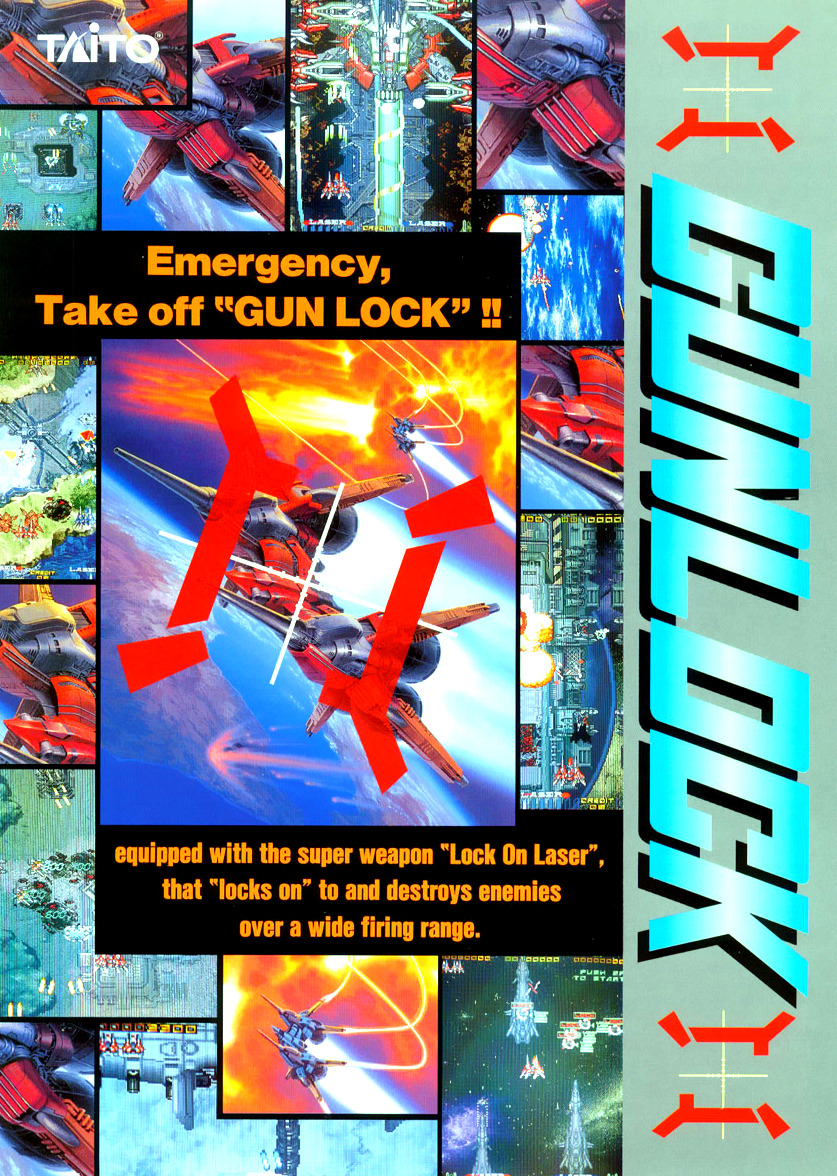
RayForce is a vertically scrolling shoot'em up by Taito on the F3 board, released in February 1994 in Japan and later the same year in North America and Europe. It was shown at the 1993 JAMMA show. For trademark reasons, it changed names: Gunlock in European arcades, Layer Section on the console versions in Japan and on Windows outside Japan, Galactic Attack on Saturn in North America and Europe from Acclaim. In the story, the computer Con-Human goes mad and turns Earth into a mobile fortress, which the RVA-818 X-LAY ship must destroy.
How it was made
Tatsuo Nakamura directs with Yukio Abe, with Tomohisa Yamashita on design and Hideyuki Katou on graphics. The team works within Taito's Kumagaya research group, which had been forbidden from making shoot'em ups. Nakamura got around the ban by writing design documents. He took inspiration from Master of Weapon for the aerial view and from Xevious for aiming at the ground, but chose a lock-on laser that hits several enemies at once. Katou gave the graphics a metallic look, as in Darius. Some versions of the game first bore the name Layer Section, a reference to the multi-plane levels.
What makes it unique
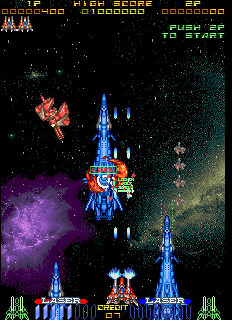
The ship has two weapons: a straight laser that grows stronger with power-ups, and a secondary lock-on laser, also upgradable, that can target up to eight enemies at once by moving a reticle. It is used to hit enemies on a lower plane, out of reach of the main shot. The team chose not to give a screen-clearing bomb, to return to the older shoot'em up format. The universe's theme is inorganic matter, an idea already used in Gradius. The music is by Taito's in-house band, Zuntata.
Good to know
The lock-on laser is where the score comes from. Within a single volley, each locked target is worth twice the one before it: the first counts once its value, the second twice, then four times, eight times, and up to one hundred and twenty-eight times for the eighth. The aim is to lock eight enemies on every shot, keeping the most valuable ones for the end of the volley, up to a cap of 99,900 points per enemy. Once the main shot is maxed out, every further power-up pays out points, from 2,000 to 10,000 in steps of 1,000, and laser power-ups follow the same rule; losing a life sends that value back to its starting point. An extra life comes at one million points, another at two million.
Its influence
Taito first worked on a sequel named R-Gear, in sprites, then replaced it with RayStorm, in polygonal 3D. A prequel, RayCrisis, came out in 1998. The game was ported to Saturn in 1995, to Windows in 1997, then to iOS in 2012 and Android in 2017. Game Machine ranked it the third most popular arcade game in its April 1, 1994 issue. The X-LAY appears as a downloadable ship in Dariusburst: Chronicle Saviours.
Text written from published sources (Wikipedia, Wikidata, specialist press).
The hardware
Texts and media: ScreenScraper.fr. Trademarks and visuals belong to their owners.