
Street Fighter II': Hyper Fighting
Street Fighter II sped up: new special moves, new palettes and a pace that makes every command more demanding. The highest-earning arcade game in Japan in 1993.
 Get the game
Street Fighter II': Hyper Fighting
- Developer
- Capcom
- Publisher
- Capcom
- Release
- 1992
- System
- Arcade
- Players
- 1-2
- Genre
- Fighting game
The story of the game
The why and the how
Street Fighter II Turbo: Hyper Fighting, called Street Fighter II Dash Turbo in Japan, is a Capcom fighting game released in arcades in 1992. It is the third arcade version of Street Fighter II, after Champion Edition, and was first sold as an upgrade kit for the latter. Released less than a year after the previous installment, it is the last in the series to use the original CP System board. It is followed by Super Street Fighter II, on the CP System II board.
How it was made
James Goddard, who provided design support on Turbo, recounted in an interview with Polygon that development began after he played the hack Street Fighter II: Rainbow Edition and warned Capcom that an update was needed to stay competitive. Akira Nishitani and Akira Yasuda are credited with the design, Yoshiki Okamoto with production, and Yoko Shimomura and Isao Abe with the music.
What makes it unique
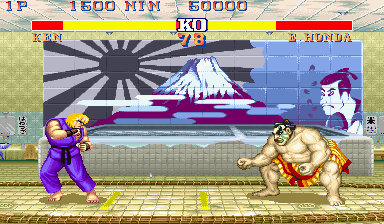
The game is faster than Champion Edition, which demands more precise timing for special moves and combos, but also lets you react faster. Almost every fighter gains a new move: Ryu and Ken can do the Tatsumaki in the air, E. Honda has the Super Body Slam, Chun-Li a projectile, the Kikoken, Zangief a Turbo Clothesline and Dhalsim a teleport. Each character receives a new default palette.
Good to know
The game speed increases compared with Champion Edition, which demands more precise timing for special moves and combos, but also gives you time to react faster. Almost every fighter gains at least one special move, except Guile and the four Grand Masters. Ryu and Ken can throw the Tatsumaki in the air, E. Honda has the Super Body Slam against aerial attacks, Blanka a vertical roll, and Chun-Li a projectile. Knowing these novelties wins rounds.
Its influence
In Japan, Game Machine ranked it second among table cabinets in January 1993, and it became the highest-earning arcade game in the country that year. The Super NES version, released on July 11, 1993 in Japan, adds the Champion Edition rules; it was re-released on the Super NES Classic Edition in 2017. The title is also available on Xbox Live Arcade with an online versus mode, and in several Capcom compilations.
Text written from published sources (Wikipedia, Wikidata, specialist press).
The hardware
Texts and media: ScreenScraper.fr. Trademarks and visuals belong to their owners.