
Street Fighter III 3rd Strike: Fight for the Future
The last chapter of Street Fighter III became a monument of fighting games: pixel-perfect parries, five new fighters and the return of Chun-Li. Long overlooked, it ended up establishing itself as a benchmark of the competitive scene.
 Get the game
Street Fighter III 3rd Strike: Fight for the Future
- Developer
- Capcom
- Publisher
- Capcom
- Release
- 1999
- System
- Arcade
- Players
- 1-2
- Genre
- Fighting game
The story of the game
The why and the how
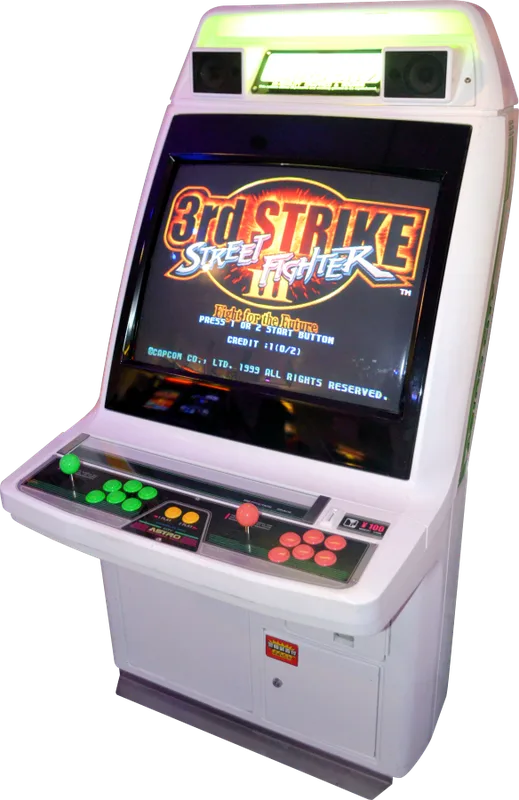
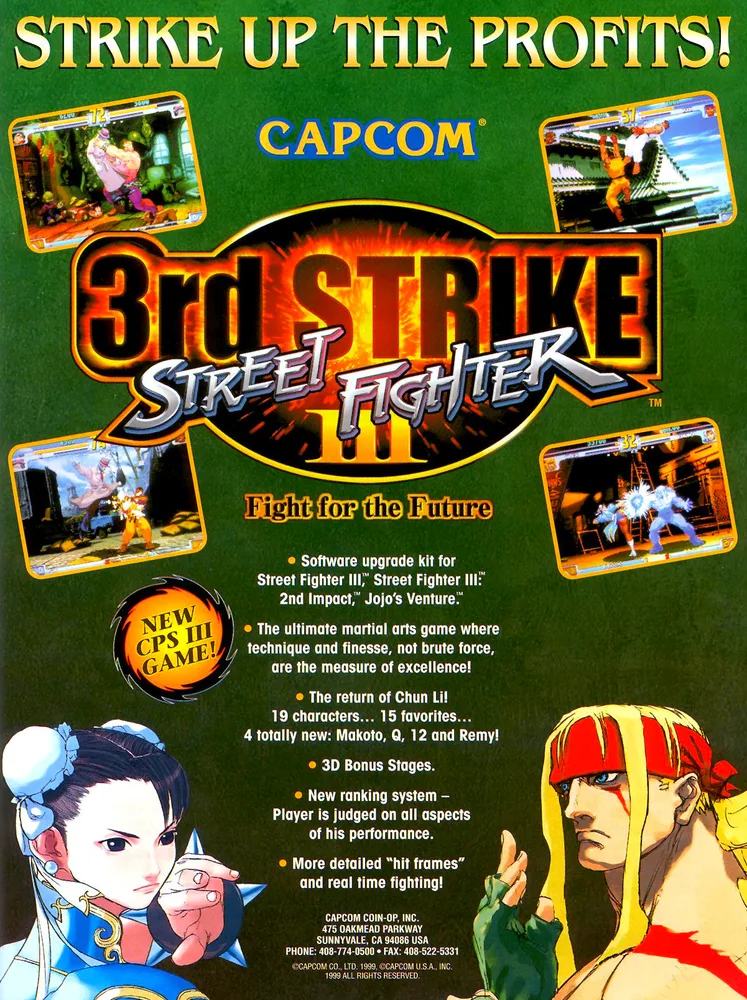
Street Fighter III: 3rd Strike - Fight for the Future is a fighting game by Capcom released in arcades in May 1999. It runs on the CP System III board, like its predecessors, and closes the series of Street Fighter III updates after 2nd Impact. Unpopular at release, it gathered good reviews, then more and more followers over the years, until it became a pillar of tournaments.
How it was made
Development began at the end of 2nd Impact and lasted nearly a year and a half, with almost the same team as the previous installment. The game was called "Second Edition" as a project, hence the numbering of the title, and Capcom chose the word "Strike" for its more immediate effect than "Impact." The team wanted polished backgrounds, to be admired in solo play, and a new soundtrack: the Canadian rapper infinite is behind the opening track. The grading system, the Grade Judge, came from a desire to judge the beauty of a fight, beyond a simple win percentage.
What makes it unique
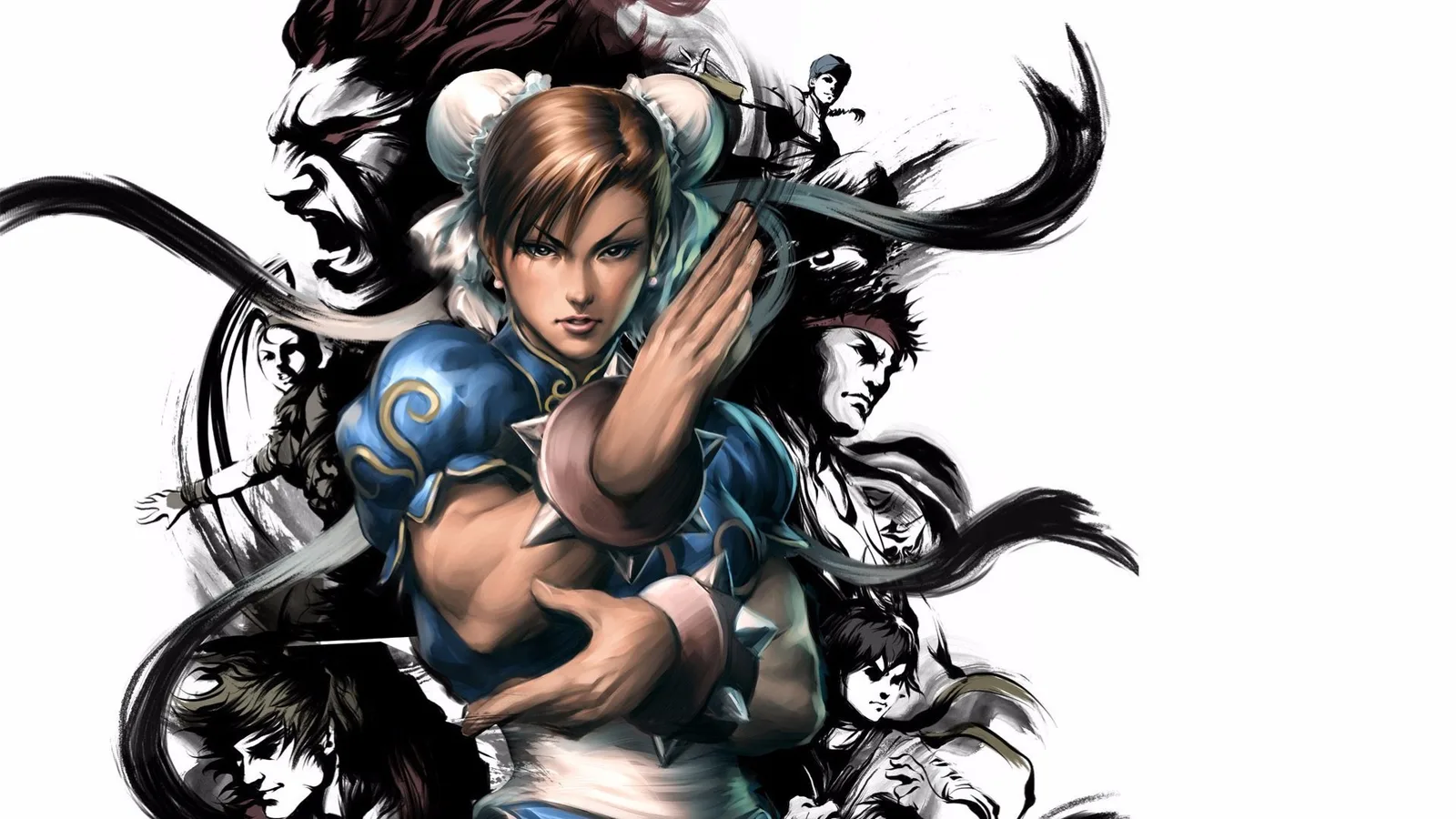
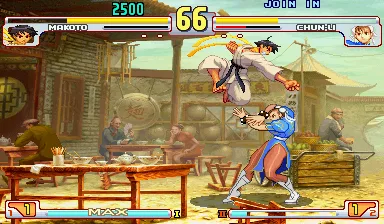
Five fighters join the roster: Chun-Li, back since Street Fighter II, as well as Makoto, Remy, Q and Twelve. The cast thus reaches nineteen characters, with Akuma now playable from the start. Each gets new stages, new endings and, for some, new voice actors. The parry system is enriched: a guard parry, called the red parry because the character turns red, becomes possible if the timing is right. The inputs for air parries, throws and jump attacks have also changed.
Good to know
In solo play you face ten opponents, including a rival specific to each character in the second-to-last position, then Gill as the final boss, except for Gill himself, who ends against Alex. Q can only be met as a secret opponent. The game introduces a judging system: after a match, the winner receives a grade based on attack, defense, technique and extra points, with special points for certain feats. Two mini-games, the ball parry and the car to destroy, round out the mode.
Its influence
The game has its place in the history of competition with Evo Moment 37, nicknamed Daigo's parry, often cited as the most emblematic instant in tournaments. As for editions, the Dreamcast welcomed it in 2000, the PlayStation 2 and Xbox in 2004 in the Street Fighter Anniversary Collection, then an Online Edition by Iron Galaxy Studios in 2011 on PlayStation 3 and Xbox 360, with GGPO online play. It has also been in the Street Fighter 30th Anniversary Collection since 2018.
we wanted to bring back that sense of tension and excitement from the early days of fighting games
Text written from published sources (Wikipedia, Wikidata, specialist press).
The hardware
Texts and media: ScreenScraper.fr. Trademarks and visuals belong to their owners.