
Street Fighter III: New Generation
A radical renewal of the series: Alex replaces Ryu as the lead, parries invent a new way to defend, and Capcom's finest 2D defies the 3D era.
 Get the game
Street Fighter III: New Generation
- Developer
- Capcom
- Publisher
- Capcom
- Release
- 1997
- System
- Arcade
- Players
- 1-2
- Genre
- Fighting game
The story of the game
The why and the how
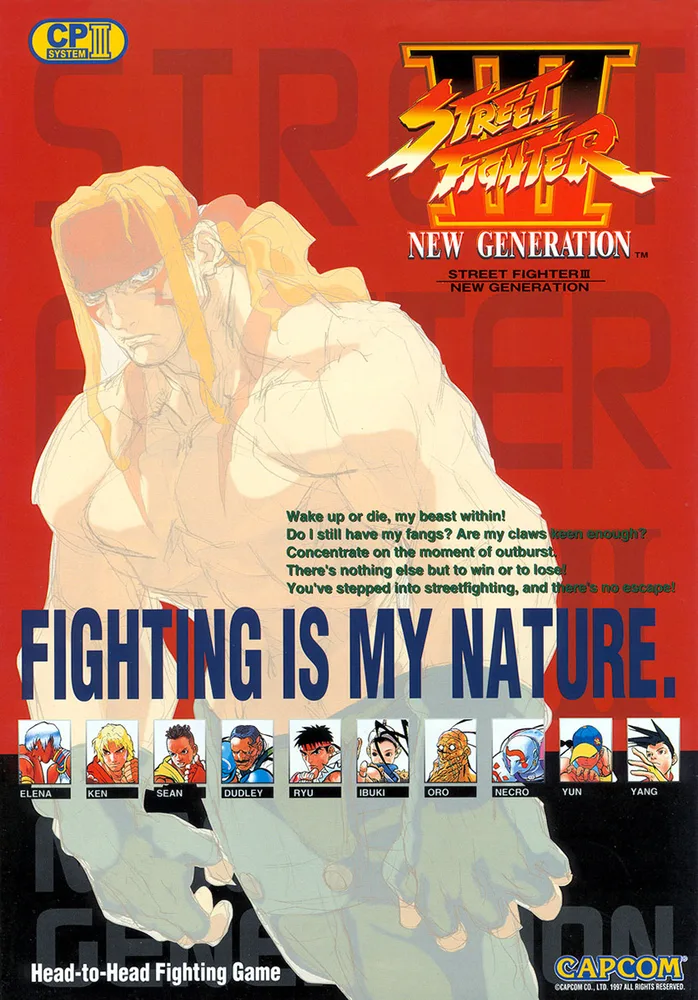
Street Fighter III: New Generation is a Capcom fighting game released in arcades in 1997. A sequel to Street Fighter II, it drops all the old characters except Ryu and Ken, hence its subtitle, and presents an entirely new cast led by Alex. A new antagonist, Gill, takes M. Bison's place. It runs on the CP System III board, which uses CD-ROM and allows more elaborate 2D graphics. Despite the fashion for polygonal 3D games, Capcom chose to stay in 2D.
How it was made
Capcom announced the game on 27 March 1996, after more than two years of work. Production began in 1994 on an original fighting game, unrelated to Street Fighter. Producer Noritaka Funamizu felt tired of the series, whose console sales were declining, in the face of the rise of 3D games like Virtua Fighter. The studio kept 2D. Akira Yasuda suggested that the first female character be a ninja, hence the creation of Ibuki.
What makes it unique
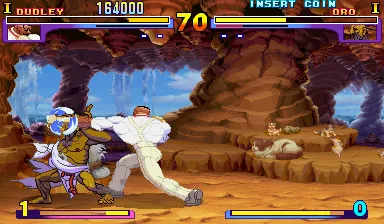
The parry changes everything: at the precise moment an attack is about to hit, you push the joystick forward or down to deflect it without taking damage, even against special moves and Super Arts, before counterattacking. The Super Arts system asks you to choose among three ultimate moves specific to each character. It features movement borrowed from Darkstalkers and super jumps from X-Men: Children of the Atom, as well as jumping attacks and more detailed sprites.
Good to know
Super Arts are paid for with the gauge, at least one level, and can be triggered by canceling a special move. The parry, which deflects an attack by pushing the stick forward or down at the right moment, avoids damage, even against special moves. The game brings movement borrowed from other Capcom games, such as the dash, the retreat, super jumps and quick recoveries. Jumping attacks and leap attacks complete the arsenal. A secret: on the selection screen, highlight Yun then press a kick button and he turns into Yang. On speedrun.com, the categories are Normal and Hardest.
Its influence
The game received a mostly positive reception but did not match the success of its predecessor. It was followed by two updates, 2nd Impact in 1997 and 3rd Strike in 1999. Its only home version arrived on Dreamcast in 1999 and 2000 in Street Fighter III: Double Impact. The next series would be Street Fighter IV in 2008. The parry, sometimes attributed to Samurai Shodown II, became the signature of this generation.
Text written from published sources (Wikipedia, Wikidata, specialist press).
The hardware
Texts and media: ScreenScraper.fr. Trademarks and visuals belong to their owners.