
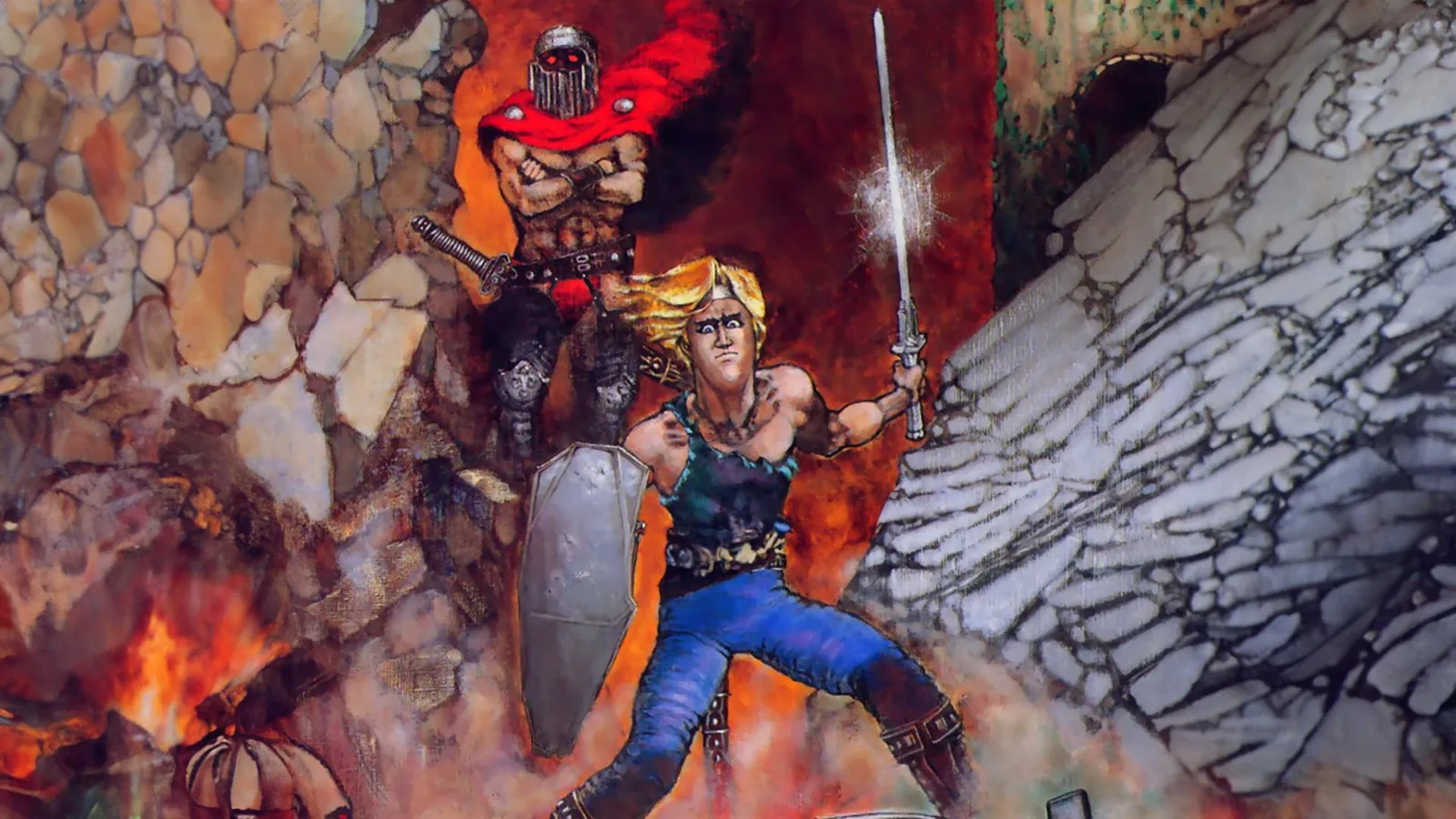

Tatakai no Banka
Known outside Japan as Trojan, a post-apocalyptic action game directed by Takashi Nishiyama, spiritual heir to Kung-Fu Master.
 Get the game
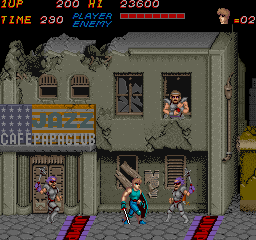
Tatakai no Banka
- Developer
- Capcom
- Publisher
- Capcom (Romstar en Amérique du Nord)
- Release
- 1986
- System
- Arcade
- Players
- 1-2
- Genre
- Scrolling action
The story of the game
The why and the how
Trojan, released in Japan under the title Tatakai no Banka, is a 1986 Capcom action game in arcades, distributed by Romstar in North America. It was directed by Takashi Nishiyama. It is the spiritual successor to Kung-Fu Master, which Nishiyama had designed at Irem before joining Capcom, where he developed his ideas further in Trojan. It has also been compared to Ghosts 'n Goblins, whose scrolling action is comparable.
What makes it unique
The story takes place in a post-apocalyptic near future, after a nuclear war. The spirits of warlords of the past have come back to life and possess the strongest of the survivors, under Achilles' command. The hero, who has taken the name Hero Trojan, must infiltrate the lands of the evil army, fight pirates and gladiators, and exorcise the hosts of their demons with his sword and shield. It is played solo or with two, with an eight-way joystick and two buttons: one for the sword, the other for the shield, with jumping done by pushing up, as in Kung-Fu Master.
Its influence
A NES version came out the same year as the cabinet and adds a duel fighting mode, a first for Capcom, a precursor to Nishiyama's work on Street Fighter in 1987. Nintendo also offered it in arcades on the PlayChoice-10. A ZX Spectrum version programmed by Clive Townsend for Elite Systems in 1987 was never released. In Japan, Game Machine ranked Trojan the sixteenth table cabinet of May 1986, and Clare Edgeley, in Computer and Video Games, saw it as a worthy successor to Ghosts 'n Goblins.
Text written from published sources (Wikipedia, Wikidata, specialist press).
The hardware
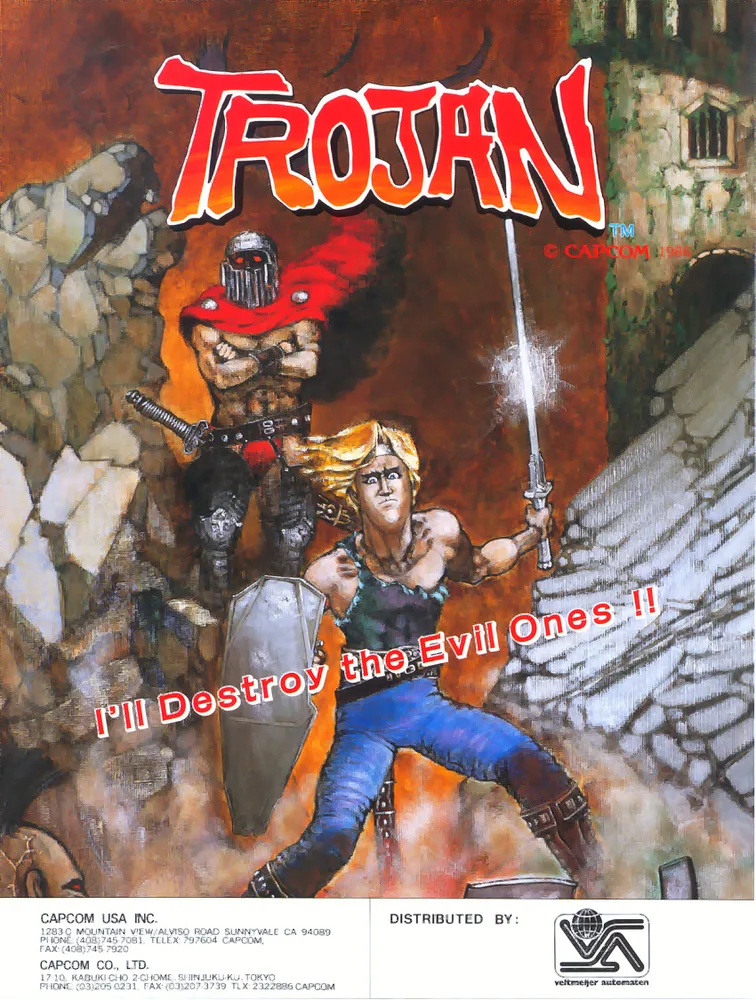
Texts and media: ScreenScraper.fr. Trademarks and visuals belong to their owners.