


Vulgus
Capcom's very first arcade game: a space shoot'em up with no distinct levels, looping until the last life.
 Get the game
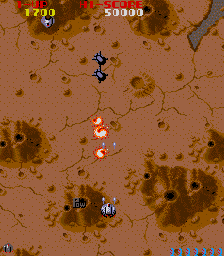
Vulgus
- Developer
- Capcom
- Publisher
- Capcom
- Release
- 1984
- System
- Arcade
- Players
- 1-2
- Genre
- Vertically scrolling shooter
The story of the game
The why and the how
Vulgus is a vertically scrolling shooter released in 1984, developed and published by Capcom for arcades. It is the company's first arcade game. Its future rival SNK distributed it outside Japan. According to Game Machine, it was among the most popular arcade games in Japan in June 1984. Roger C. Sharpe, in Play Meter, gave it a fairly favorable review.
How it was made
Vulgus came out in May 1984. It is the first game produced by Capcom, whose name comes from Capsule and Computer and which Kenzo Tsujimoto founded in Japan to manufacture and distribute game machines. Tokuro Fujiwara directs the game, with T. Toyohara, M. Kimura, Y. Morita, A. Fukada and S. Okada. It was only sold as a conversion kit, by Capcom or, outside Japan, by SNK. In the American version, the score table accepted three initials, whereas the Japanese version allowed ten letters.
What makes it unique
The player commands a ship whose only goal is to destroy the incoming enemies. It has two weapons: a main weapon with unlimited ammunition and a limited number of bombs. Pow icons, which appear from time to time, replenish the supplies. As in Xevious, there are no distinct levels: the scenery alternates between planet surface and space, and the game restarts with increased difficulty until all lives are lost.
Its influence
The Pow icon is reused in many Capcom games, such as 1941: Counter Attack, Bionic Commando and Savage Bees. The Yashichi, an enemy in the game, also returns, most often as a bonus. Valgas, a boss in Power Stone, takes its name from the game. Vulgus was published for free in 2001, then appears in several compilations such as Capcom Classics Collection in 2005. A sequel for the NES, Titan Warriors, never came out.
Text written from published sources (Wikipedia, Wikidata, specialist press).
The hardware

Texts and media: ScreenScraper.fr. Trademarks and visuals belong to their owners.