
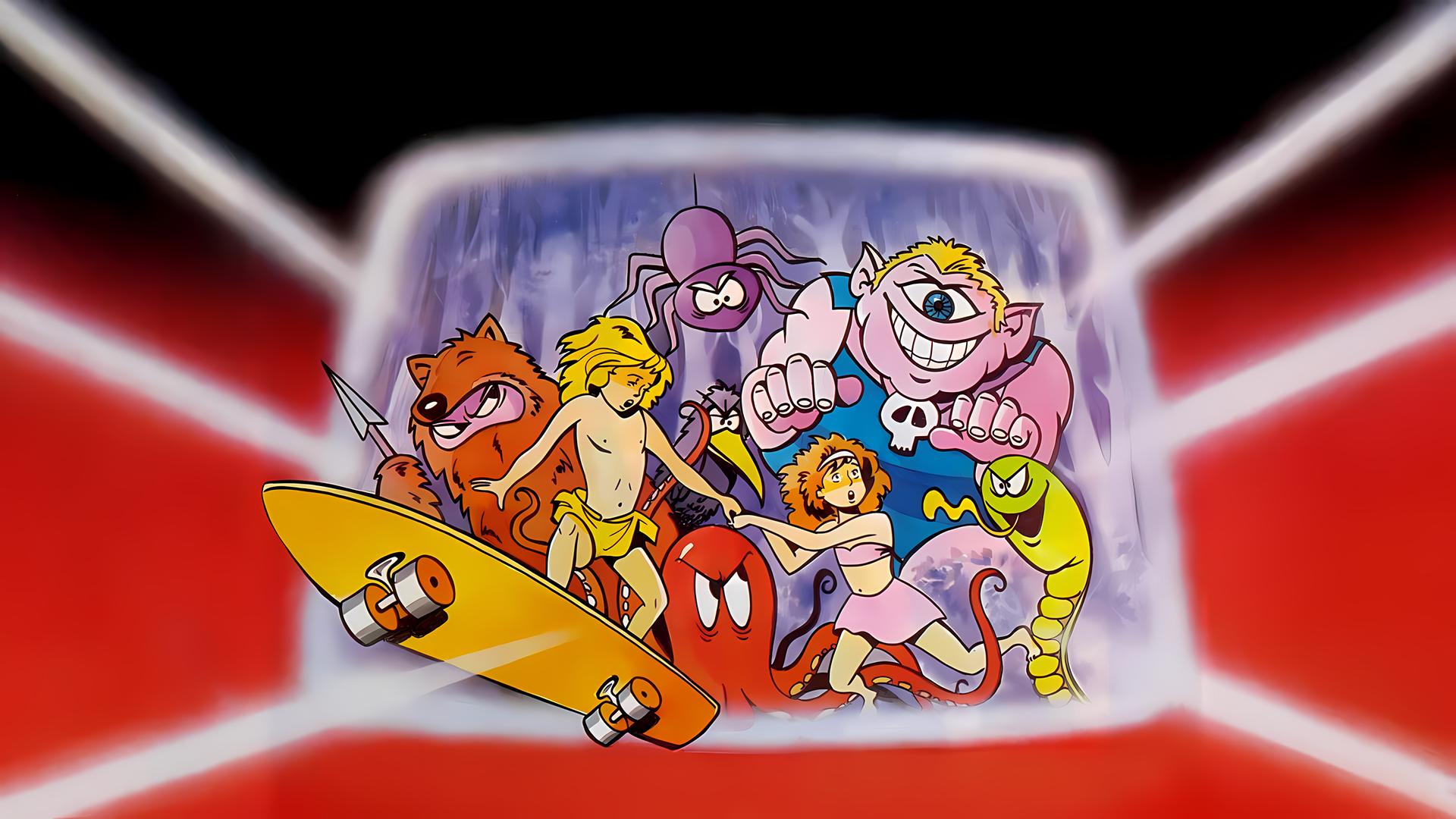

Wonder Boy
A boy from ancient times, a stone axe and a vitality bar that never stops draining: in 1986 Wonder Boy opened a series of six games, starting in a Sega arcade.
 Certified scoring
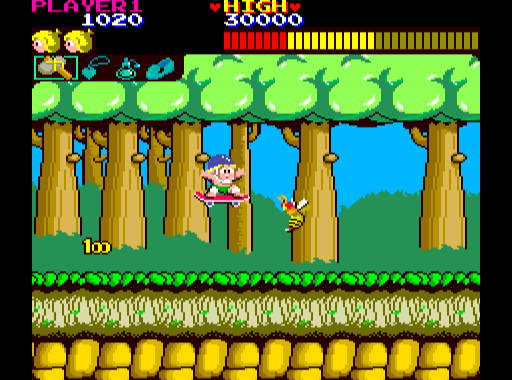
Wonder Boy
- Developer
- Escape (Westone)
- Publisher
- Sega
- Release
- 1986
- System
- Arcade
- Players
- 1-2
- Genre
- Platformer
The story of the game
The why and the how
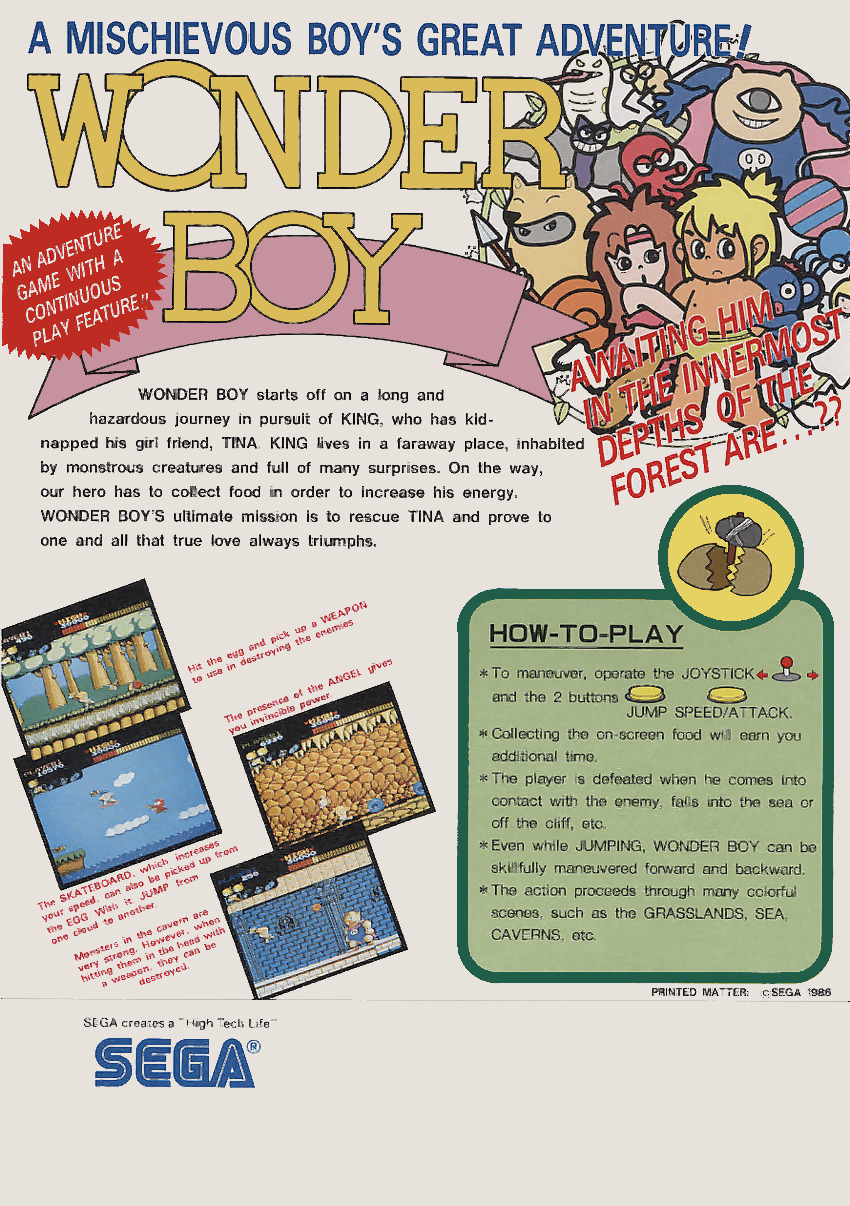
Wonder Boy was released in arcades in Japan on April 21, 1986. Sega published it and Escape, a studio later known as Westone, developed it. The game runs on the Sega System 1 board. It started a series that would count five sequels: Wonder Boy in Monster Land, Wonder Boy III: Monster Lair, Wonder Boy III: The Dragon's Trap, Wonder Boy in Monster World and Monster World IV. The story fits in a few words: a boy from ancient times sees his girlfriend Tina kidnapped by a dark king, and crosses an island of forests, hills, oceans, caves and ice palaces to find her.
How it was made
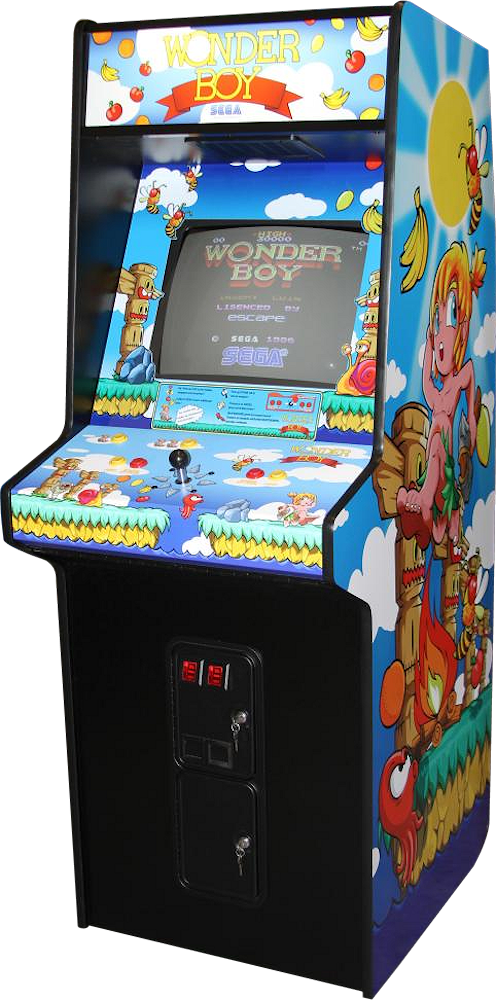
Ryuichi Nishizawa is credited as director, designer and composer of Wonder Boy, developed by his company Escape. The cabinet plays with a two-way joystick and two buttons: one to jump, the other to throw the weapon. The arrangement between the two companies had a particularity: Escape kept the rights to the game design, while Sega kept the Wonder Boy trademark. This split explains how another version of the game could appear at another publisher, under another name.
What makes it unique
The game scrolls from left to right through seven areas of four rounds, each ending with a boss. The hero can only kill an enemy once he has found a stone weapon, hidden with other items in big eggs: a skateboard that lets him race through the level, or an angel that protects him for a while and destroys whatever he touches. Some eggs, recognizable by their red spots, hold traps: a curse that speeds up the loss of vitality, or a poisonous mushroom. Above all, vitality drops continuously and only the food picked up along the way refills it. With two players, you take turns.
Good to know
Each round ends with a bonus count. A doll is hidden in every round: picking it up doubles the end-of-round bonus, and collecting all 28 dolls opens an eighth area. According to our .MEM file, the score is stored on three bytes in binary-coded decimal, and the value read is multiplied by ten to get the points on screen. The same file tracks the number of lives, the current round (four per area) and whether the doll was collected. The cabinet setting fixes three, four or five starting lives, with extra lives earned at 30,000 points and then every 70,000 or 90,000 points depending on the setting.
Its influence
Wonder Boy is the first game of a series whose sequels change formula, from arcade to console. Sega itself ported the game to the SG-1000 in 1986, then to the Mark III in Japan on March 22, 1987 under the title Super Wonder Boy, and to the Game Gear on December 8, 1990. Activision published versions for the ZX Spectrum, Commodore 64 and Amstrad CPC in 1987. Later, Hamster offered the arcade game on PlayStation 4 in its Arcade Archives line, in 2014. This 1986 arcade version remains the reference that the ports followed, closely or loosely.
Text written from published sources (Wikipedia, Wikidata, specialist press).
The hardware
Texts and media: ScreenScraper.fr. Trademarks and visuals belong to their owners.